dice
The opend6_tools.dice module is a small DSL for dice specifications.
This is shared by the opend6_tools.magic and opend6_tools.character modules.
A class definition implements operators to support
n *D and D+ n, where n is a number.
It will also support more complex operations like 3*D + 4*D + 2.
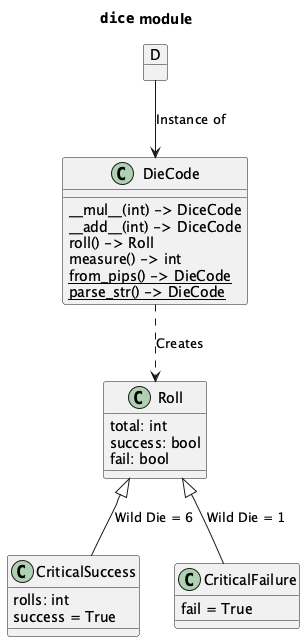
The global object D is the essential ingredient here.
It permits an expression like:
DamageEffect("Attack", 3*D+2)
Additionally, this module also offers a command-line interface: an dice command.
(opend6-tools) % dice --help

 Usage: dice [OPTIONS] [EXPR]

 Roll the handful of dice described by a dice expression. Use the --count
 option to roll multiple times.

 ? is a critical failure showing a total with the largest die value excluded, and, in ()'s, the total of all dice.

 ! is a critical success followed by the number of re-rolls.

╭─ Arguments ───────────────────────────────────────────────────────────────╮
│   expr      [EXPR]  Dice expression, example: '2*D6+3' (quotes are        │
│                     *required*)                                           │
╰───────────────────────────────────────────────────────────────────────────╯
╭─ Options ─────────────────────────────────────────────────────────────────╮
│ --count               -c      INTEGER  number of times to roll            │
│                                        [default: 1]                       │
│ --install-completion                   Install completion for the current │
│                                        shell.                             │
│ --show-completion                      Show completion for the current    │
│                                        shell, to copy it or customize the │
│                                        installation.                      │
│ --help                                 Show this message and exit.        │
╰───────────────────────────────────────────────────────────────────────────╯
Implementation
A DSL for dice definitions.
The most important global object is D, which is the basis for the DieCode DSL.
Example:
>>> from opend6_tools.dice import D
>>> 3*D + 2
3*D+2
- class opend6_tools.dice.DieCode(n: int | Decimal = 1, adj: int | Decimal = 0)[source]
Specifications for collections of dice. Computes the overall measure, \(3 \times d + p\).
>>> from opend6_tools.dice import *
>>> r = 3*D+2
>>> r.measure
Decimal('11')
>>> repr(r)
'3*D+2'
Can also parse a text specification.
>>> t = DieCode.parse_str("3D+2")
>>> t.measure
Decimal('11')
>>> repr(t)
'3*D+2'
A degenerate case of only pips, not clear why someone might need this.
>>> DieCode.parse_str("2")
0*D+2
>>> 0*D + 2
0*D+2
>>> from random import seed
>>> seed(42)
>>> physique = 4*D
>>> [str(physique.roll()) for _ in range(12)]
['17!', '13!', '12? (18)', '6? (11)', '10', '13', '23', '15', '16!', '10', '9', '12']
- __init__(n: int | Decimal = 1, adj: int | Decimal = 0) None[source]
Create a working DieCode instance, usually the global
D.
- n
Number of dice
- adj
Additional pips
- property d: int
Legacy attribute reference, now a property.
- classmethod from_pips(pips: int | Decimal) DieCode[source]
Converts number of pips to Die + Pips.
- Parameters:
pips – pips value
- Returns:
DieCode
- property measure: Decimal
The overall measure associated with this DieCode.
- classmethod parse_str(text: str) DieCode[source]
Parse a string representation of a DieCode object, example:
"3D+2".The syntax has three closely-related forms:
[+]n[*]D+n|[+]n[*]D|+nPragmatically,
+and*are essentially whitespace. The meaningful tokens are strings of digits andD. The three interesting forms are nDn, nD, and n.
- roll() Roll[source]
The “Wild Die” roll algorithm.
This returns several things:
Ordinary result: a
Rollinstance.- Critical Success, wild die was 6.
A
CriticalSuccessinstance.
- Critical Failure, wild die was 1.
Two totals (with and without the highest die value.) A
CriticalFailureinstance.
- __weakref__
list of weak references to the object
- class opend6_tools.dice.Roll(die: list[int], pips: int, rolls: int)[source]
A single roll of the dice.
- die: list[int]
The die values
- fail: ClassVar[bool] = False
- pips: int
Additional pips to add
- rolls: int
Number of rolls (>1 for Critical Success)
- success: ClassVar[bool] = False
- property total: int
Total of Die plus bonus pips
- class opend6_tools.dice.CriticalSuccess(die: list[int], pips: int, rolls: int)[source]
Bases:
RollA single roll that was a Critical Success – Wild Die was 6.
- class opend6_tools.dice.CriticalFailure(die: list[int], pips: int, rolls: int)[source]
Bases:
RollA single roll that was a Critical Failure – Wild Die was 1.
This includes the dice_app CLI.
- opend6_tools.dice.main(expr: ~typing.Annotated[~opend6_tools.dice.DieCode, <typer.models.ArgumentInfo object at 0x10a8f4ec0>], count: ~typing.Annotated[int, <typer.models.OptionInfo object at 0x10a846210>] = 1)[source]
Roll the handful of dice described by a dice expression. Use the –count option to roll multiple times.
? is a critical failure showing a total with the largest die value excluded, and, in ()’s, the total of all dice.
! is a critical success followed by the number of re-rolls.